Sweet · Austria
Eiswein
Zantho — Burgenland, Austria · 2020
- Grape(s)
- Welschriesling
- Vintage
- 2020
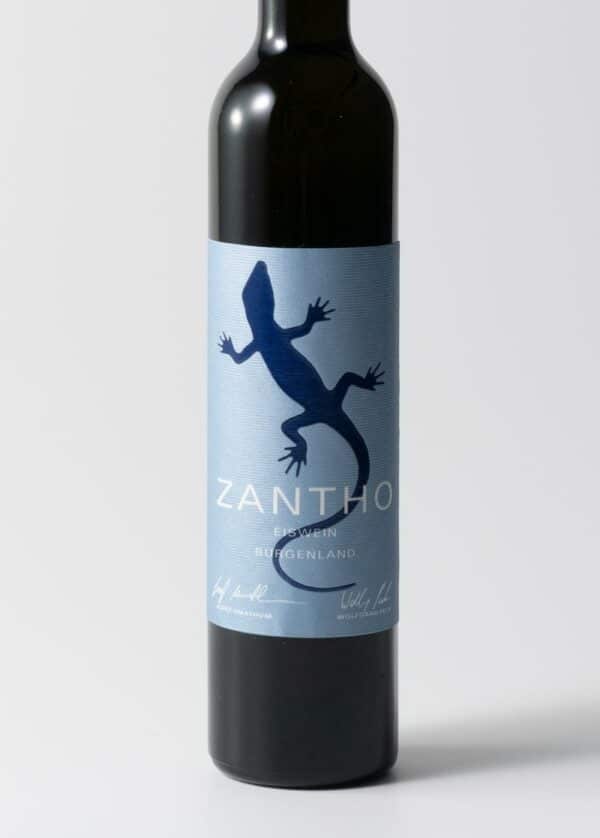
There’s something almost stubborn about Eiswein. It exists because a grower decided not to pick a perfectly good crop of grapes in October, left them hanging through frost after frost, and gambled on a hard enough freeze before rot or birds took the lot. This bottle is what that gamble looks like when it pays off.
History
Zantho was founded in 2002 in the village of Andau, in the Seewinkel — a joint effort between Josef Umathum, an already well-regarded local winemaker, oenologist Wolfgang Peck, and a group of growers from the Domaine Andau cooperative who wanted to push toward more serious, estate-driven winemaking rather than staying purely cooperative bulk production. The name itself is a small piece of local history: “Zantho” is the old Magyar name for Andau, taken from a document dating back to 1487, from back when this stretch of the border region sat under Hungarian administration.
Region & terroir
Andau sits in the Seewinkel, the flat, lake-dotted landscape on the eastern shore of the Neusiedlersee in Burgenland — Austria’s easternmost wine region and its warmest, thanks to the moderating presence of the lake. The Neusiedlersee is large, shallow, and slow to cool, which means through late summer and autumn it holds heat that the surrounding land has already lost. That mismatch between warm lake water and cooling night air produces heavy morning fog that can sit over the vineyards until well into the day, and the resulting humidity — especially around the shallow salt ponds locally called Zicklacken — is what makes this one of the most reliable places in Europe for noble rot to develop most vintages. It’s worth being precise here, though: that lake-driven fog is what makes Seewinkel famous for botrytis wines like Beerenauslese and Ausbruch. Eiswein runs on an entirely different, unrelated mechanism — it needs a hard winter freeze, not autumn humidity — and this bottle is a reminder that the region can deliver both, by two completely different routes, sometimes from the very same vineyard.
The grape
Welschriesling has nothing to do with Riesling beyond the borrowed name — a persistent bit of consumer confusion that’s worth clearing up. Ampelographically the two are unrelated; Welschriesling is generally thought to have originated somewhere around Croatia or the wider Danube basin, and it turns up across Central and Southeastern Europe under a handful of regional aliases: Graševina in Croatia, Riesling Italico in parts of Italy, Laški Rizling in Slovenia. On its own the grape is something of a workhorse — crisp, high in acid, pleasant but rarely profound as a dry wine. What makes it interesting here is its thin skin, which leaves it wide open to botrytis and, in a year like this, to the kind of prolonged hang time that Eiswein demands.
Winemaking
Under Austrian wine law, Eiswein grapes have to freeze naturally on the vine and be harvested and pressed while still frozen solid — commonly understood to require temperatures down around -7°C, with a minimum must weight matching that of Beerenauslese. The wine can’t even go forward for official certification until the following spring, which gives some sense of how much of this is left to chance and patience rather than a winemaker’s control. The mechanism itself is simple physics rather than biology: freezing turns the water inside each berry to ice, and when the frozen grapes are pressed, most of that ice stays behind in the press as solid crystals, leaving only a small trickle of intensely concentrated, syrupy juice to run off. That’s the whole trick — no rot, no biological transformation, just cold doing the concentrating. It’s a genuinely different process from a Beerenauslese or Trockenbeerenauslese, where Botrytis cinerea dehydrates the berries on the vine and layers in its own flavour compounds along the way — honeyed, dried-apricot, faintly saffron notes that Eiswein, by design, doesn’t have.
Tasting notes
Nose: Bright, high-toned orchard fruit — green apple, quince, a little white peach — with none of the honeyed, oxidative character you’d get from a botrytis-affected sweet wine.
Palate: Intensely sweet but startlingly fresh, carried by Welschriesling’s naturally high acidity. Ripe stone fruit and candied citrus peel, with a clean, almost crystalline texture rather than the syrupy weight of a late-harvest wine.
Finish: Long, tart, and refreshing rather than cloying — the acid keeps pulling the sweetness back into balance right to the end.
Serving & pairing
Serve cold, around 8°C, in a small glass — this isn’t a wine you drink in large measures. Its freshness makes it a natural partner for fruit-based desserts (a tarte tatin, poached pear) or something with a bit of blue cheese to play off that acidity; it can also just as easily be poured entirely on its own as a reflective, after-dinner glass.
Why it’s in the cellar
Every bottle of Eiswein is a small bet a grower made against the weather months earlier, and you can taste that patience in the glass. It’s in the cellar less because it’s rare — Burgenland makes this style reliably — and more as a reminder that some of the best things really do just take longer than everything else.