Spirit · Bulgaria
Troyanska Slivova Special Reserva
Vinprom Troyan — Troyan, Bulgaria
- Grape(s)
- Plum Distillate
- ABV
- 40%
- Vintage
- 25-year-old
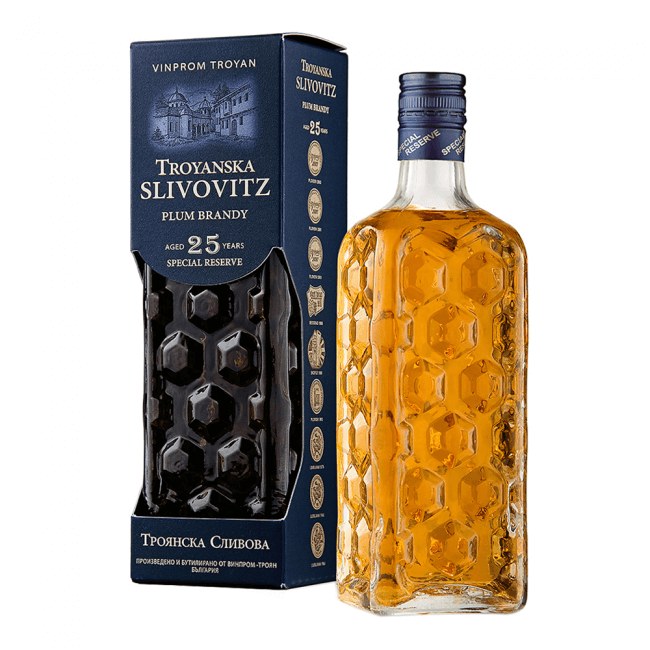
Most rakia is drunk within a year or two of being distilled, straight and unaged, at a village table rather than out of a considered glass. This bottle is the exception that proves the rule wrong — a spirit that spent a quarter of a century deciding it wanted to be something closer to Cognac.
History
Troyan, tucked into the Balkan Mountains, is one of Bulgaria’s oldest and most respected centres for plum rakia, a reputation built on the region’s long-standing plum orchards and a distilling tradition old enough that Bulgaria overall has documented alembic-still fragments dating back to the fourteenth century. “Troyanska Slivova Rakya” carries a European Union Protected Geographical Indication — registered in 2005 — meaning the name is legally tied to production in the Troyan area specifically, the same kind of protection Cognac or Parmigiano-Reggiano rely on. Exactly how far back Vinprom Troyan itself as a company goes is genuinely murky — different accounts put it anywhere from a nineteenth-century founding to a mid-twentieth-century one — so rather than pin down a specific year, it’s fairer to say the company sits inside a plum-distilling tradition in this exact valley that’s considerably older than the business itself.
Region & terroir
The Balkan Mountains around Troyan have long been known for their plum orchards, and the local climate and soil are generally credited with producing fruit dense and flavourful enough to be worth distilling rather than just eating — the whole reason a “Troyan-specific” rakia designation exists at all.
The grape
There’s no grape in this bottle — it’s a plum distillate, made the same way rakia has always been made in this part of the Balkans: fermented plum mash run through a copper pot still, traditionally fired by wood or charcoal.
Winemaking
Quality rakia is almost always double-distilled — a first pass to separate out the roughest material, a second to refine and concentrate it into something cleaner and smoother than the coarser, single-distilled rakia found at the lower end of the market. What sets this bottle apart isn’t the distillation, though, it’s what happened afterward: twenty-five years resting in oak, decades longer than the vast majority of rakia ever sees, which is normally bottled young and colourless within a year or two of being made. That length of time in wood does what it does to any spirit — slow oxidation softens the harsher, more fusel-heavy edges of the raw distillate, the wood contributes colour and vanilla-and-spice notes, and a quarter-century of evaporative loss concentrates what’s left into something considerably richer and more complex than a young, clear rakia ever gets the chance to become.
Tasting notes
Nose: Caramelised plum, dried stone fruit, and warm baking spice, with a rounded oak sweetness that a young rakia simply doesn’t have.
Palate: Smooth and integrated, ripe plum and dried apricot carried by a gentle, well-worn warmth rather than raw alcohol heat.
Finish: Long, warm, and layered — closer in feel to an aged brandy than to the sharp, clear rakia most people know.
Serving & pairing
Serve neat, at room temperature, in a small glass — this isn’t a spirit to rush. It works well alongside dried fruit, dark chocolate, or a strong aged cheese, or simply as a slow digestif to close out a meal.
Why it’s in the cellar
Twenty-five years is an eccentric amount of patience to apply to a spirit most people drink within the year it’s made. It’s in the cellar as proof that even the most rustic, everyday traditions can turn into something genuinely serious if somebody’s willing to just wait.