Red · Bulgaria
Mavrud Reserva
Edoardo Miroglio — PDO Nova Zagora · Thracian Valley · 2022
- Grape(s)
- Mavrud
- ABV
- 14.5%
- Vintage
- 2022
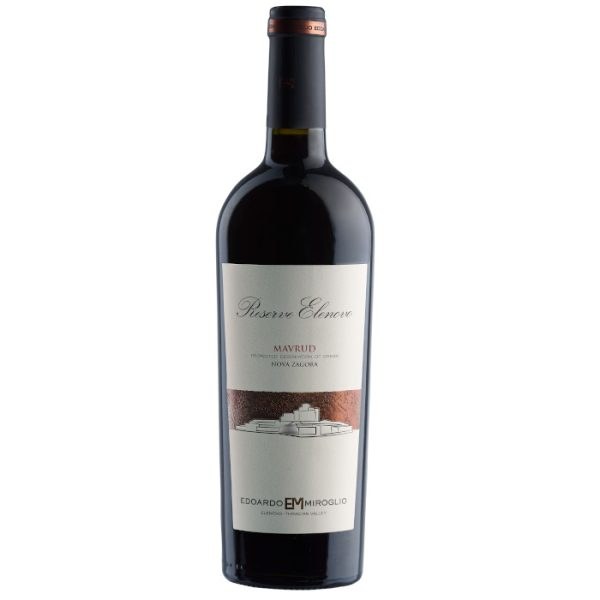
Mavrud has a traditional home, and this isn’t it. That’s most of what makes this bottle interesting — a grape planted somewhere it isn’t supposed to be, by someone who wasn’t from here either.
History
Edoardo Miroglio, an Italian textile and wine entrepreneur who already owned an estate in Piedmont, went looking for new vineyard land outside Italy and settled on a site near the village of Elenovo, southeast of Nova Zagora in Bulgaria’s Thracian Valley, in 2002. The first vintage followed in 2005, and the estate — now run by his son Franco, with winemaking historically guided by an Italian-Bulgarian team — has grown to over 220 hectares planted with a mix of international varieties and Bulgaria’s own indigenous grapes, Mavrud among them.
Region & terroir
Mavrud’s traditional heartland is Asenovgrad, near Plovdiv, further west and south in the Thracian Valley. This estate sits considerably further northeast, near Nova Zagora and Sliven, on clay-slate soils above Elenovo — a genuinely different pocket of the same broader valley, which makes growing Mavrud here as much an experiment in relocating a grape as it is a straightforward regional wine.
The grape
Mavrud is Bulgaria’s most distinctive indigenous red grape — the name comes from the Greek word for black — and by most accounts it has the greatest ageing potential of any of the country’s native varieties. It’s late-ripening, low-yielding, thick-skinned, and genuinely difficult to grow: not especially cold-hardy, prone to mildew, but resistant to grey rot in a way that rewards patience through a long autumn. The wines it produces are deeply coloured, high in both tannin and acidity, with blackberry, black cherry, and liquorice character, and a well-documented affinity for oak ageing that tames its naturally aggressive tannin into something more structured.
Winemaking
This bottling spends 24 months in 500-litre Bulgarian oak barrels — a larger, gentler format than a small French barrique, which lets the wine soften and integrate without picking up an overwhelming amount of direct oak flavour. That extended, larger-format ageing is the modern answer to Mavrud’s naturally fierce tannin: rather than fighting the grape’s structure, long oak contact gradually resolves it into something more approachable while preserving the variety’s depth.
Tasting notes
Nose: Ripe cherry, dried leaves, mushroom, and walnut — an earthy, autumnal profile alongside the dark fruit.
Palate: Supple tannins for a grape known for its grip, with black cherry and liquorice carried by real acidity and a savoury, forest-floor undertone.
Finish: Long and smoky, with the clay-slate soils showing through as a mineral, almost stony edge underneath the fruit.
Serving & pairing
Serve at cool room temperature, around 16–18°C, ideally decanted for half an hour to let the tannins soften further. It’s built for rich, slow-cooked meat — lamb, game, or anything with real umami depth — and for hard, aged cheeses.
Why it’s in the cellar
Mavrud grown outside its traditional home is still a genuinely open question in Bulgarian winemaking, and this bottle is one estate’s confident answer to it. It’s in the cellar as much for that experiment as for what’s actually in the glass.