Sparkling · France
Demi-Sec NV
Taittinger — Champagne
- Grape(s)
- Chardonnay, Pinot Noir
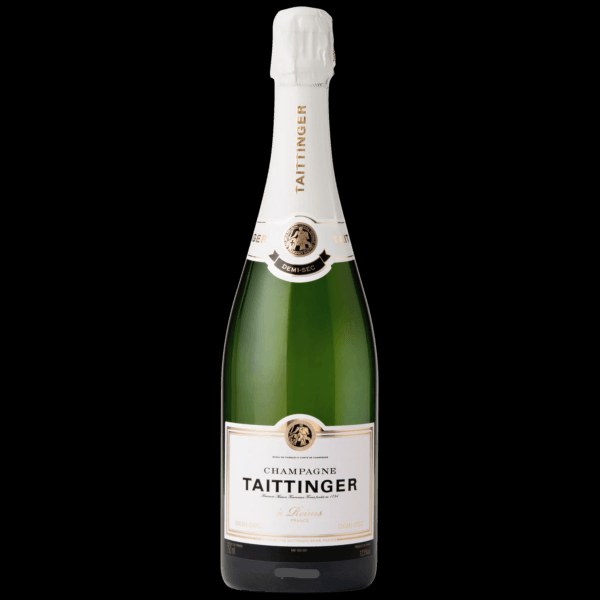
Demi-Sec is the Champagne style most people have never actually chosen — it gets served by accident at brunch, or dismissed as “sweet Champagne” before it’s been tasted properly. It deserves better than either.
History
Taittinger’s history stretches back to 1734 under a different name, becoming the house it is today when Pierre Taittinger — who first fell for the region while stationed near Épernay during the First World War — bought into the company in 1931 and acquired Château de la Marquetterie the following year. It remained under his family’s control for decades, was sold to outside investors in 2005, and was bought back by the founder’s grandson the following year — one of relatively few grandes marques still under the name on the label.
Region & terroir
The estate draws on close to 300 hectares across the Côte des Blancs, the Vallée de la Marne, and the Montagne de Reims, giving it fruit from genuinely different terroirs to build its blends from rather than relying on one sub-region’s character alone.
The grape
This wine blends Chardonnay and Pinot Noir in the house’s classic style — the same base philosophy behind Taittinger’s other cuvées, built here around a very different finishing decision than usual.
Winemaking
Every Champagne, however dry it ends up tasting, gets a small dosage — a mixture of wine and sugar — added just before final corking to round off the acidity built up during fermentation. How much sugar goes in decides which category the wine falls into: Brut Nature carries almost none, Brut (the most common style) stays under 12 grams per litre, and Demi-Sec sits at 32 to 50 grams per litre — three to four times the sugar of a standard Brut. That’s a genuinely different wine, not just a sweeter version of the same one: at that dosage level, the sugar starts to play an active role in the flavour rather than just rounding off sharp edges, which is exactly why Demi-Sec is built to go with dessert rather than to open a meal.
Tasting notes
Nose: Ripe orchard fruit, honey, and brioche, with a noticeably richer, rounder impression than a Brut from the same base wine.
Palate: Off-dry and generous, baked apple and apricot sweetness balanced by Champagne’s underlying acidity, so it never tips into cloying.
Finish: Medium-long, warm, and fruit-driven, with the sweetness lingering pleasantly rather than sitting heavy.
Serving & pairing
Serve chilled, around 8–10°C, and actually pair it — that’s the whole point of the style. A fruit tart, a not-too-sweet dessert, or a soft, mild cheese like Brie all give it something to work with; it’s a genuinely poor match for savoury food, which is exactly why it gets overlooked at the wrong moments.
Why it’s in the cellar
Most people’s only experience of sweet Champagne is a bottle poured badly at the wrong time. This one’s in the cellar to be opened at the right time instead — with dessert, on purpose, so the style gets a fair shot.
More from Taittinger