Sweet · Hungary
Gold Label Aszú 6 Puttonyos
Royal Tokaji — Tokaj · Hungary · 2017
- Grape(s)
- Furmint
- ABV
- 10.5%
- Vintage
- 2017
- Recognition
- ★ 96 pts Wine Enthusiast
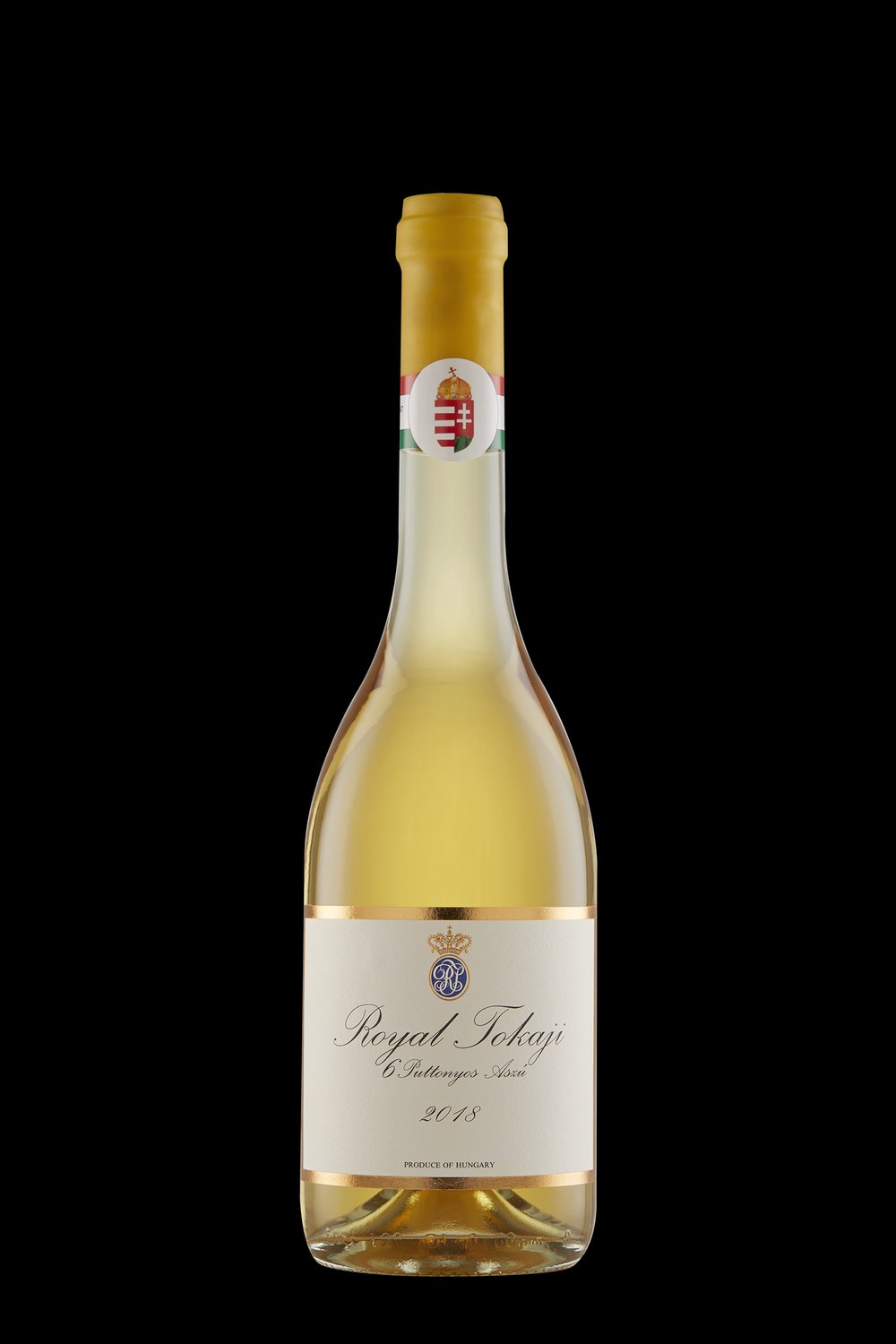
Some wines are ordered by the glass. This one is ordered by the barrel, the harvest pass, the individually shriveled berry — a level of deliberateness that shows up the moment you pour it.
History
Royal Tokaji was founded in 1990 in the village of Mád, generally regarded as the first serious private investment in Tokaj winemaking after decades of Communist-era state control had flattened the region’s reputation into bulk, industrial production. The house is closely associated with the British wine writer Hugh Johnson, who is widely credited as the driving figure behind its founding alongside a small group of investors — part of a wider wave of new estates in the early-to-mid 1990s that set out to rebuild vineyard-designated, quality-focused Aszú production almost from scratch after privatisation.
Region & terroir
Tokaj sits in northeastern Hungary, near the Zemplén hills, at the point where the Bodrog and Tisza rivers meet. The region’s hills are volcanic in origin, with bedrock of rhyolite and andesite beneath a mix of reddish clay and darker volcanic-derived topsoils — geology that was significant enough, combined with the area’s centuries-old hand-carved cellar network and its role in the historical development of the Aszú style itself, to earn Tokaj UNESCO World Heritage status in 2002. Just as important as the soil is the humidity generated near the river confluence: morning mists roll in much the way they do around Burgenland’s Neusiedlersee, and that reliable humidity is what makes Tokaj one of the most dependable places in the world for Botrytis cinerea, the noble rot that this entire style depends on, to take hold most autumns.
The grape
Furmint is the backbone of Tokaj for a simple reason: it has the acidity to carry an enormous amount of sugar without collapsing into something cloying. It’s also thin-skinned, which sounds like a liability anywhere else but here is exactly the point — that thin skin lets moisture escape as the grape raisinates and gives botrytis an easy way in. Furmint is also increasingly bottled as a serious dry white in its own right, but its historic role, and the one it plays in this bottle, is as the raw material for Aszú.
Winemaking
Aszú production starts with hand-harvesting individual botrytis-shrivelled berries in repeated passes through the vineyard as they raisinate — a far slower, more selective process than a single mechanised harvest. Those berries are crushed into a thick paste, macerated briefly with must or young base wine, and then added to a barrel of base wine to ferment and age together. The traditional Tokaj barrel, the gönci, holds 136 litres, and the number of puttonyos — historically the count of baskets of that aszú paste added per barrel — is what determines how sweet and concentrated the finished wine becomes.
That system used to run from 3 to 6 puttonyos, but the regulations changed with the 2013 harvest: the legal minimum residual sugar for anything labelled Aszú was raised to 120 grams per litre, which effectively pushed the old 3- and 4-puttonyos levels below the threshold altogether. In practice, 5 and 6 puttonyos are now the only meaningful rungs left on that traditional ladder, with 6 puttonyos sitting at the richer, more concentrated end.
Tasting notes
Nose: Dried apricot, orange peel, honey, and a faint saffron-like note that’s characteristic of well-developed botrytis.
Palate: Intensely sweet but never flabby — the wine’s high natural acidity cuts straight through the sugar, keeping it lively rather than syrupy. Dried stone fruit, marmalade, and a mineral, almost saline thread underneath.
Finish: Long, honeyed, and clean, with the acidity carrying the sweetness all the way through rather than letting it sit heavy.
Serving & pairing
Serve well-chilled, around 8–10°C, in a small glass — this is a wine for sipping slowly, not pouring generously. It’s the classic partner for foie gras (a pairing Tokaj has been famous for since long before it was fashionable elsewhere), but it’s just as at home with a strong blue cheese, or on its own as a slow, contemplative glass at the end of a meal.
Why it’s in the cellar
This is a wine that rewards knowing what went into it — the repeated hand-picking, the patient barrel work, a labelling system that only survives today in its top two tiers because the rest didn’t meet the bar. It’s in the cellar as a reminder that “sweet wine” and “serious wine” aren’t opposites.