Spirit · Ireland
21 Year Old Single Malt
Bushmills — County Antrim, Ireland
- Grape(s)
- Single Malt Irish Whiskey
- ABV
- 40%
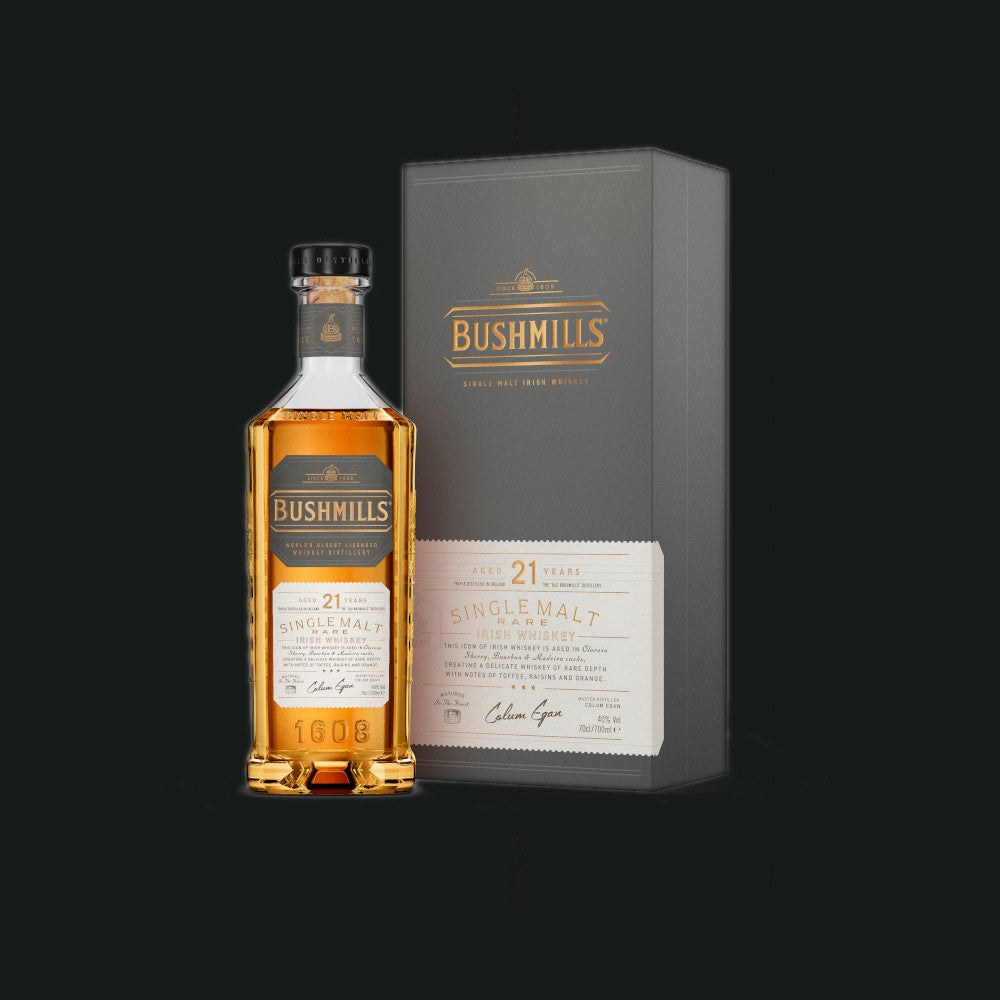
Every bottle of Bushmills carries the number 1608 somewhere on its packaging, and every bottle is, strictly speaking, telling a slightly simplified version of its own history. That doesn’t make it any less worth having in the cellar — it just makes the real story more interesting than the label.
History
In 1608, King James I granted a licence to Sir Thomas Phillips, a local landowner, permitting distilling in the district around Bushmills — the source of the 1608 date on every bottle. That’s a licence to distil in the area, though, not evidence of a continuously operating company; the Old Bushmills Distillery Company as an actual business was registered by Hugh Anderson in 1784, and even that history isn’t unbroken — records show gaps in operation in the early 1800s, and the distillery was destroyed by fire in 1885 before being rebuilt. So “the world’s oldest licensed distillery” is more a marketing simplification of a genuinely old and storied site than a literal, uninterrupted 400-year run. Ownership has passed through several hands since — Irish Distillers, then Pernod Ricard, then Diageo, and since 2014, Proximo Spirits.
Region & terroir
Bushmills sits in County Antrim on Ireland’s northern coast, close to the Giant’s Causeway, drawing its water from the nearby River Bush — the source of the distillery’s name and, the house maintains, part of what shapes its house style.
The grape
There isn’t a grape here — this is 100% malted barley, distilled entirely at one site, which is what “Single Malt Irish Whiskey” actually means. It’s worth clearing up a common misconception on the way: triple distillation isn’t a legal requirement for Irish whiskey the way it’s sometimes assumed to be — Irish law only requires that the spirit be made and matured on the island of Ireland. Bushmills triple-distils by house style and choice, not by any national rule.
Winemaking
Triple distillation means passing the spirit through the still three times instead of the two that’s standard in Scotland, and each additional pass narrows the cut further — stripping out more of the heavier, water-soluble compounds and concentrating the lighter, more delicate ones. The general effect is a smoother, lighter-bodied spirit than a typical double-distilled malt, though the degree of that smoothness has as much to do with exactly where the distiller cuts the spirit as it does with the number of passes itself. This 21 Year Old spends the bulk of its maturation split across ex-Oloroso sherry and ex-bourbon casks before a final finishing period in Madeira casks — three different wood influences stacked on top of each other. Oloroso brings dried fruit, fig, and Christmas-cake spice; bourbon casks contribute vanilla, coconut, and a mellow sweetness; the Madeira finish layers in an oxidative, nutty, dried-fruit character with a lift of acidity that the other two casks don’t have on their own.
Tasting notes
Nose: Dried fruit and toffee from the sherry cask, vanilla and honey from the bourbon influence, with a nutty, slightly grapey lift from the Madeira finish.
Palate: Rich and rounded — raisin, baked apple, toasted nuts, and warm spice, with the smoothness that comes from three passes through the still.
Finish: Long, warm, and gently oxidative, the Madeira cask’s dried-fruit character carrying through to the very end.
Serving & pairing
Drink neat or with a single large ice cube — this is a whiskey with enough going on that it doesn’t need a mixer to prove its worth. It pairs naturally with dried fruit, dark chocolate, or a mature cheddar, or simply on its own after dinner.
Why it’s in the cellar
The number on the label tells one story; the barrels tell a more interesting one. It’s in the cellar as much for that layered cask history as for the age statement itself — proof that “oldest” and “best” are usually two different questions.