Red · Bulgaria
Grande Cuvée
Bessa Valley — Thracian Valley · 2020
- Grape(s)
- Cabernet Sauvignon, Merlot, Syrah, Petit Verdot
- Vintage
- 2020
- Recognition
- ★ DiVino Top 50 Bulgaria 2024
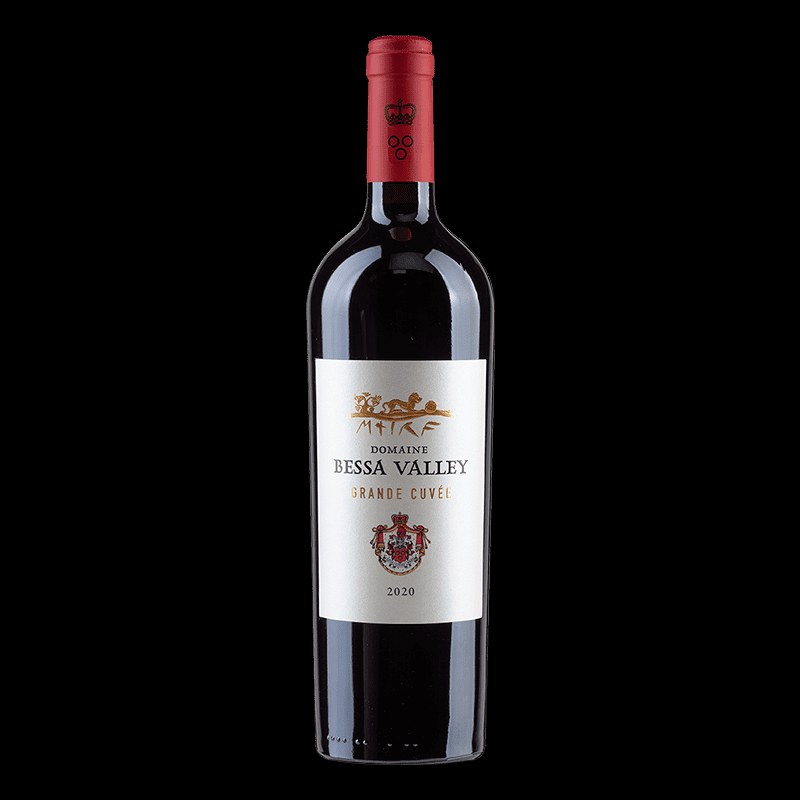
Bordeaux expertise doesn’t often travel well — the whole point of terroir is that it’s specific. This bottle is one of the better arguments that it can travel anyway, if the person bringing it takes the new place seriously enough.
History
Bessa Valley was founded in 2001 near the village of Ognyanovo, in the Thracian Lowlands southeast of Sofia, by Count Stephan von Neipperg — owner of Château Canon-la-Gaffelière and Château La Mondotte in Saint-Émilion, among other Bordeaux estates — together with Bulgarian-based investment partner Dr. Karl-Heinz Hauptmann. The estate’s name refers to the ancient Thracian Bessi tribe who once inhabited the area, and the land itself was assembled by buying out roughly 800 individual smallholders’ plots — a genuinely unusual, patient way to build a single estate from scratch.
Region & terroir
The vineyard sits on clay-limestone soils that von Neipperg reportedly chose specifically because of their resemblance to Saint-Émilion’s own terroir, on hills between the Rhodope Mountains and the Maritsa River in Bulgaria’s Thracian Lowlands. It’s a continental climate — hot summers, cold winters — that’s earned the wider Thracian Valley a strong reputation for full-bodied, structured reds.
The grape
Grande Cuvée is Bessa Valley’s top wine, a Bordeaux-style blend of Petit Verdot, Merlot, Syrah, and Cabernet Sauvignon sourced from the estate’s lowest-yielding parcels. Petit Verdot’s presence in particular is a Bordeaux winemaker’s signature move — it’s a variety almost always used in small proportions elsewhere for the tannin, colour, and spice it contributes, and here it plays a genuinely leading role in the blend rather than a supporting one.
Winemaking
Each variety is fermented and vinified separately before blending, sourced from parcels farmed down to roughly 40 hectolitres per hectare — a deliberately low yield aimed at concentration over volume — before 18 months in 100% new French oak. That combination of low-yield fruit and entirely new oak is a distinctly Bordeaux approach to building a top-tier red, applied here to grapes grown a very long way from Saint-Émilion.
Tasting notes
Nose: Blue plum, blackberry, and cacao, with the toasted, spiced lift of new French oak still clearly present.
Palate: Full-bodied and velvety, dark fruit and chocolate carried by firm but polished tannins — structured enough to reward real cellar time.
Finish: Long and layered, oak and fruit still settling into each other rather than fully resolved.
Serving & pairing
Serve at cool room temperature, decanted for at least an hour given the youth and new-oak structure. It’s built for rich red meat — a good steak, slow-braised lamb — and firm, aged cheeses.
Why it’s in the cellar
This is a wine that has years of development still ahead of it, and that’s precisely the point. It’s in the cellar as one of the more convincing proofs that Bordeaux-calibre ambition can take root somewhere entirely unexpected.
More from Bessa Valley