Sparkling · France
L'Échappée Belle Blanc de Blancs
Étienne Calsac — Champagne
- Grape(s)
- Chardonnay
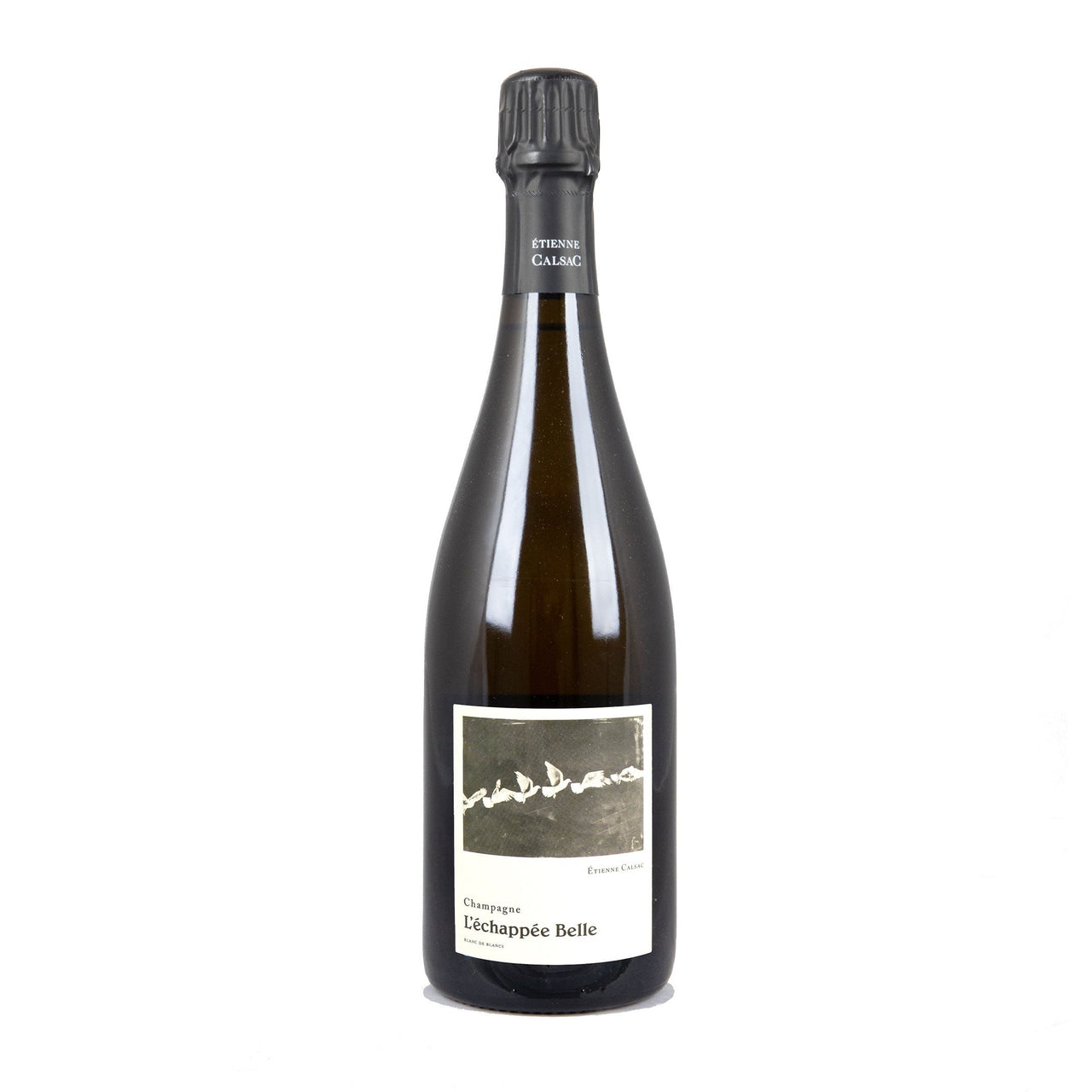
Most of what’s in this cellar comes from grandes marques — the big houses whose names do a lot of the talking before the wine gets a chance to. This one’s the opposite: a grower Champagne, made start to finish by the person who grew the grapes, from a single village most people outside the trade have never heard of.
History
Étienne Calsac’s family sold grapes to the big Champagne houses for generations, the way most growers in the region did — vines as a cash crop for someone else’s label. That changed in 2010, when Calsac, then 26, inherited the family’s holdings in Avize and decided to make the wine himself rather than sell the fruit on. L’Échappée Belle — “the great escape” — is as much a description of that decision as it is a cuvée name.
Region & terroir
Avize sits in the Côte des Blancs, the strip of Champagne built almost entirely around Chardonnay, and one of its Grand Cru villages. The chalk here runs close enough to the surface that vine roots reach it directly, and it’s that chalk — porous, cool, mineral — that gives Côte des Blancs Chardonnay its characteristic tension: high acidity, a saline edge, and none of the richer, rounder fruit you’d get from Chardonnay grown further south. Calsac farms his plots organically, by hand, parcel by parcel, which matters more for a small grower than for a big house simply because there’s no blending across a huge portfolio to smooth over a bad decision in any one vineyard.
The grape
100% Chardonnay, the variety Avize is built on. Grown this far north, on this soil, Chardonnay doesn’t ripen into anything fat or tropical — it stays lean, high-acid, and mineral, which is exactly the raw material Champagne’s method is designed to work with. A single-grape, single-village wine like this one is also a more exposed style than a blended house Champagne: there’s nowhere for a weak parcel or an off vintage to hide.
Winemaking
L’Échappée Belle isn’t vintage-dated — it’s built on a base wine from a single recent harvest topped up with a meaningful share of older reserve wine kept back from previous years, the same principle every non-vintage Champagne relies on to keep its house style consistent from bottling to bottling. What sets a small grower’s version apart is how tight that reserve system is: Calsac is working with a handful of hectares rather than a few hundred, so the reserve blend is a much more hands-on, batch-by-batch decision than it would be at a big house’s scale. The wine finishes as an Extra Brut, dosed at just a few grams per litre — barely a fraction of standard Brut — so almost nothing is added to round off the acidity before disgorgement. This bottle was disgorged in July 2025, a detail growers like Calsac print because it matters: a Champagne changes character in the months right after disgorgement, and knowing the date tells you roughly where in that window the bottle is.
Tasting notes
Nose: Green apple, crushed stone, and citrus zest, with a faint brioche note underneath from lees ageing — restrained rather than bready.
Palate: Taut and precise, dominated by that chalky, saline Côte des Blancs minerality, with tart apple and lemon rather than any richness or roundness.
Finish: Dry, long, and bracing — the low dosage leaves nothing to soften it, which is exactly the point of an Extra Brut done well.
Serving & pairing
Serve properly cold, around 8°C, in a white wine glass rather than a flute — this is a wine with enough going on that it’s worth actually smelling. Its acidity and minerality make it a strong match for oysters, other raw shellfish, or a simple goat’s cheese; anything richer or sweeter will just fight the wine rather than complement it.
Why it’s in the cellar
Big-house Champagne is easy to default to because the names are familiar. This one’s here as a reminder that some of the most precise, terroir-driven Champagne in the region comes from a grower with a few hectares in one village, not a marque with a marketing department.